
29/04/2026




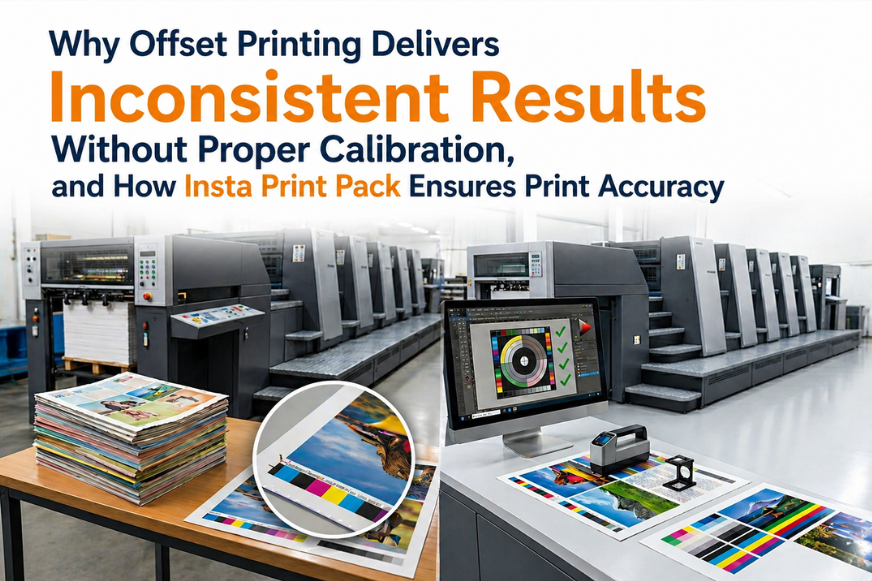
Offset printing is the industry standard for high-volume brand production. Brands rely on it for packaging, labels, and commercial print runs because it delivers sharp detail and consistent colour at a cost that digital printing simply cannot match at scale.
But it is also one of the most technically demanding processes in commercial print production. When calibration is off — even slightly — the results appear as colour shifts between batches, uneven ink density, misaligned registration, and surface inconsistencies that ultimately reach your customers and buyers.
For brand managers and product leads, these are not just printing problems. They are brand consistency problems. This article explains why calibration failures happen in print production, what they cost in time and money, and how a structured approach to accuracy prevents them from affecting your final output.
Q. Why does offset printing produce different results across print runs even when using the same design file?
The same design file does not guarantee the same printed output. The offset printing process transfers ink through rollers and plates — and every variable, from ink viscosity to paper coating and humidity, affects the final result. Without active calibration at each stage, small deviations compound and become visible differences between batches. The design stays the same. The process does not.
Offset printing produces output by transferring ink from a plate to a rubber blanket, then onto the substrate. The accuracy of that transfer depends on a controlled chain of variables — ink formulation, plate exposure, blanket pressure, and drying conditions. Each must be calibrated precisely across the full print run.
A 2022 Smithers Pira report found that colour inconsistency causes over 35% of all commercial print rejections. For brands producing packaging at volume, a single rejected batch means delayed timelines, increased cost, and gaps in product availability that affect retail commitments directly.
The challenge is that the press is a mechanical system. It drifts. Ink viscosity changes with temperature. Rollers wear. Plates lose sharpness over long runs. Without calibration protocols, these drifts accumulate — and output at the end of a 50,000-unit run looks different from output at the start.
Colour is the most sensitive indicator of print quality. Ink density, plate pressure, and substrate absorbency all affect how a colour reads on the finished sheet. Without calibration checkpoints, the same Pantone or CMYK specification produces visibly different results across runs — creating shelf inconsistency that customers notice immediately.
Ink density must remain stable across the full run. As the offset printing machine operates at high speed, ink consumption varies across coverage areas. Without active density monitoring, the balance shifts gradually — producing output that appears overinked or underinked compared to the approved proof.
Registration is the precise alignment of each colour layer in a multi-colour print. When the offset printing press is not calibrated for tension and gripper alignment, colours shift relative to each other — producing blurred edges and text that loses sharpness. On packaging, misregistration makes even a well-designed product look poorly produced.
Substrate lots vary in coating weight and absorbency. Without recalibrating ink settings to match the specific material batch in use, offset printing errors remain invisible at proof stage and only appear in the final output — too late to correct without a costly reprint.
For jobs using UV offset printing, the curing stage is as critical as the print stage. UV inks cure through ultraviolet light — and variations in lamp intensity or belt speed affect cure completeness. Undercured prints have poor scratch resistance, causing surface failure during packaging assembly or transit.
Managing quality requires active process control throughout the offset printing process — not just a final check. A properly controlled production run includes:
• Plate exposure verification before the run — confirming dot gain and tonal range match the approved specification
• Ink density measurement at regular intervals using a densitometer
• Registration checks at startup and after any press stop or paper change
• Substrate batch verification before production begins
• Final output comparison against the approved press proof
Brands working with print services that follow these protocols receive consistent output — not results that vary depending on when during the run they were printed.
For brands evaluating commercial print partners or searching for a reliable offset printing press near me, the critical question is not just whether a supplier can print — it is whether they have calibration systems to deliver consistent output across every run, every batch, and every SKU.
Insta Print Pack operates with structured calibration protocols built into every production stage. Every job starts with substrate verification and plate exposure confirmation. Ink density is monitored throughout the run. Registration is checked at startup and after every press interruption. Output is compared against the approved proof before sign-off.
For brands reordering packaging across extended production cycles, this approach ensures batch three looks identical to batch one. Insta Print Pack's offset printing services are built for brands that cannot afford visible inconsistency in their printed output.
Always Approve a Press Proof Before Full Production Begins
Always approve a physical press proof before committing to a full run — especially for packaging. A digital proof and a press proof are not equivalent under production conditions.
Specify Substrate Requirements in Your Print Brief
Do not leave substrate selection to the printer. Specify board weight, coating type, and finish in your brief. Different substrates produce different results even with identical ink settings on the same press.
Request Density and Registration Records for Each Run
Professional print services maintain production records for every job. Request and review these records against your approved specification — they reveal process consistency and flag issues before they become customer-facing problems.
Offset printing delivers the colour accuracy and cost efficiency that high-volume brand production requires. But those results depend on active calibration and structured process controls — not assumption.
Offset printing errors caused by uncalibrated presses and uncontrolled ink density are preventable. Brands working with offset printing services built around consistent calibration protocols protect their brand identity across every print run. For more information, Contact Us.
Why does colour look different between two print runs of the same job?
Ink density drift and substrate variation between runs produce visible colour differences even from the same design file.
What causes registration errors in offset printing?
Uncalibrated plate tension and gripper settings shift colour layers, producing blurred edges and lost print sharpness.
How does the offset printing process maintain colour consistency across long runs?
Active ink density monitoring and regular calibration checks throughout the run maintain consistent colour output.
What is UV offset printing and when should brands use it?
UV offset printing uses ultraviolet-cured inks that deliver superior scratch resistance and finish on premium packaging.
How do I find reliable offset printing services for packaging production?
Choose a print partner with documented calibration protocols, press proof approval, and production records per job.