
20/04/2026





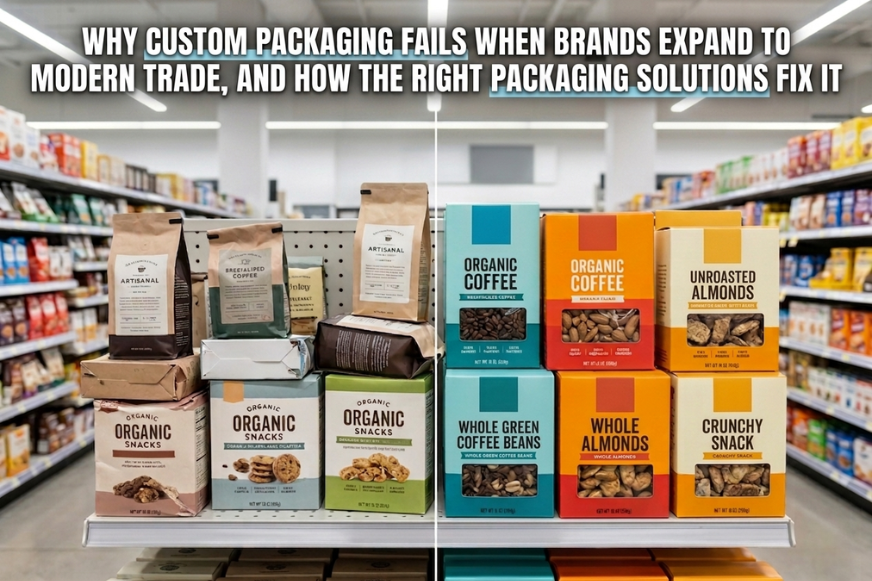
For many growing brands, entering modern trade, such as supermarkets, retail chains, and large distribution networks, is a major milestone. It opens access to larger audiences, higher volumes, and stronger brand visibility. However, this transition also exposes a critical weakness that many brands overlook: their existing custom packaging is not built for modern trade environments.
Packaging that works well for small-scale distribution or direct-to-consumer channels often fails when exposed to the operational demands of retail chains. From shelf display requirements to logistics handling and compliance standards, modern trade introduces new challenges that require more advanced packaging strategies.
Many brands experience issues such as damaged packaging, inconsistent shelf presentation, or rejection by retail partners, not because of product quality, but because their packaging was not designed for this level of scale and complexity.
Q.1 Does custom packaging need to change when entering modern trade?
Yes. Packaging designed for smaller sales channels often lacks the structural strength, compliance, and consistency required for modern retail environments. Without adapting packaging, brands can face operational and commercial challenges.
When brands expand into retail chains, packaging must perform beyond aesthetics. Several key factors cause packaging failure at this stage.
In modern trade, products go through multiple handling stages:
Packaging that was designed mainly for branding may not withstand this process.
For example, custom folding cartons used for smaller batches may collapse, deform, or lose shape when stacked in bulk or exposed to pressure during transit.
Retail chains expect consistency. Every product unit on the shelf must look identical.
However, when production scales up, many brands face:
This creates a fragmented shelf appearance, which weakens brand perception.
This is especially critical in branding & packaging, where consistency directly impacts consumer trust.
Retail shelves are highly competitive. Products are placed next to dozens of alternatives, and packaging must perform visually.
Common issues include:
Even well-designed packaging can fail if it is not optimized for real retail conditions.
Modern trade comes with strict packaging standards, including:
Many brands entering retail for the first time face packaging rejection simply because these requirements were not considered during design.
Retail distribution requires packaging that works efficiently in bulk handling systems.
This includes:
Custom food packaging, for example, must maintain both product safety and structural integrity throughout distribution.
Without proper design, packaging may lead to:
To succeed in modern trade, brands must shift from basic packaging design to strategic packaging solutions.
Packaging must be engineered to withstand real-world conditions.
This includes:
Well-designed custom folding cartons maintain shape and strength even under pressure.
Consistency is critical for retail success.
Advanced production processes help maintain:
This ensures that every product unit looks identical on the shelf.
Packaging should be designed with retail standards in mind from the beginning.
This includes:
By addressing these factors early, brands can avoid costly rework or rejection.
Efficient packaging design improves both protection and cost efficiency.
Key considerations include:
Proper custom packaging solutions reduce damage during transit while improving supply chain efficiency.
Packaging must deliver both visual appeal and operational performance.
A strong branding & packaging strategy ensures that packaging:
This balance is essential for long-term retail success.
As brands transition into modern trade, they require packaging that goes beyond basic design.
Insta Print Pack works with brands to develop custom packaging solutions that are aligned with retail, logistics, and production requirements.
These capabilities help brands avoid common packaging failures and ensure smooth expansion into modern trade environments.
Test packaging for:
Packaging should be designed not just for current volumes, but for future growth.
Experienced providers of custom packaging solutions can identify risks early and help optimize packaging for retail success.
Packaging design should consider both branding and performance, not just aesthetics.
Expanding into modern trade is a significant step for any brand, but it also brings new challenges that packaging must address. Custom packaging that works for smaller channels often fails under the demands of retail distribution, leading to damage, inconsistency, and operational inefficiencies.
By focusing on structural strength, production consistency, compliance, and logistics optimization, brands can develop packaging that performs effectively in modern trade environments.
With the right approach to custom packaging solutions and a strong understanding of branding & packaging, businesses can ensure their products not only reach retail shelves but also stand out and perform successfully. For more information, Contact Us.
Why does packaging fail in modern trade?
Packaging often fails due to lack of structural strength, inconsistent production, and not meeting retail requirements.
How is retail packaging different from small-scale packaging?
Retail packaging must handle bulk logistics, shelf display, and compliance standards, unlike smaller-scale packaging.
What role does custom packaging play in retail success?
Custom packaging helps ensure product protection, consistent branding, and better shelf visibility.
Why is consistency important in packaging?
Consistency improves brand recognition and ensures a uniform shelf presence across all products.
How can brands prepare packaging for modern trade?
Brands should focus on structural design, material selection, compliance, and working with experienced packaging partners.