
20/05/2026




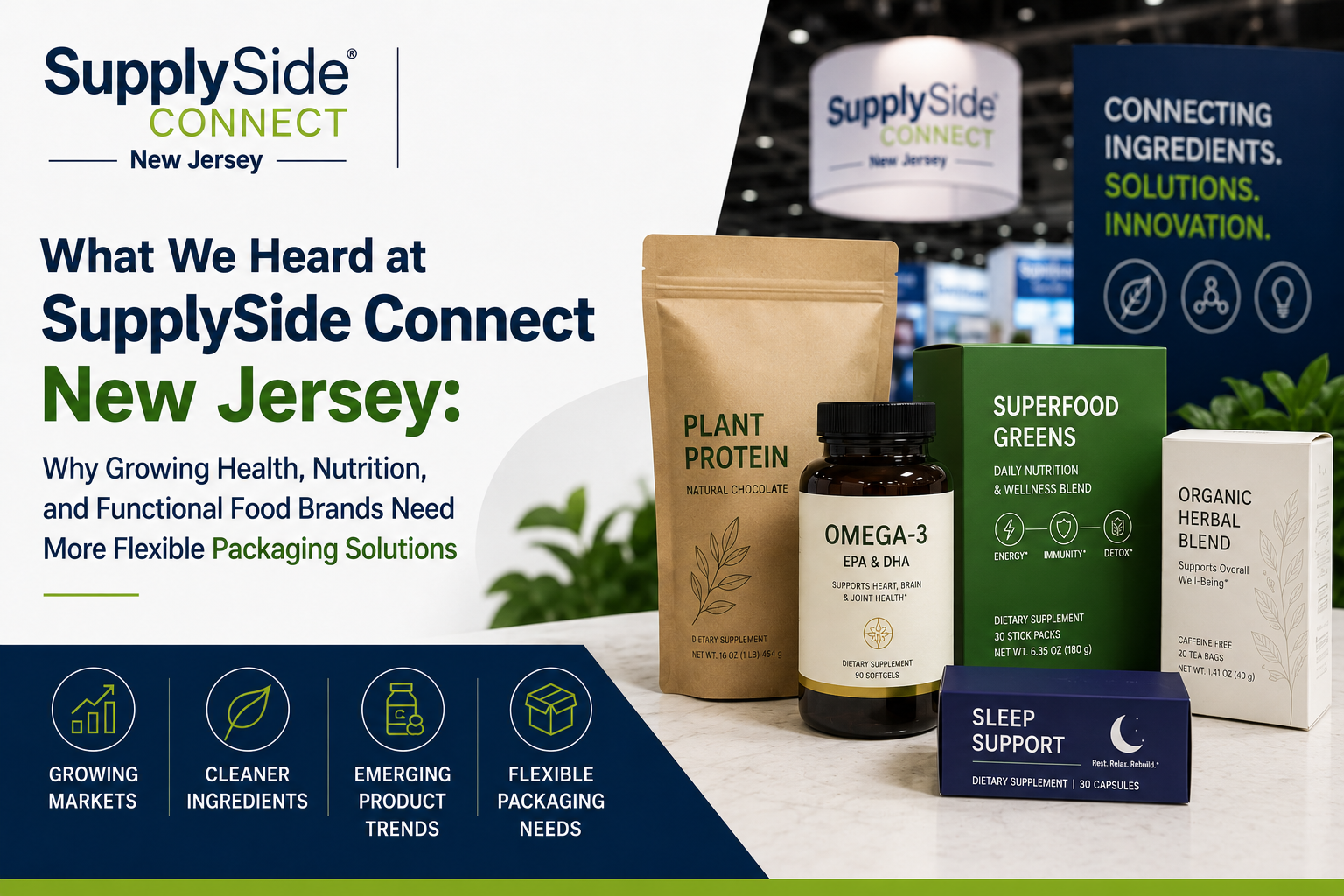
The health, nutrition, supplement, and functional food industries are evolving fast. Brands are launching products quicker, testing more concepts, entering new markets, and managing increasingly complex supply chains. While innovation is accelerating, one operational challenge continues to slow many businesses down, packaging.
At SupplySide Connect New Jersey, the Insta Print Pack team had direct conversations with founders, product teams, and brand decision-makers navigating exactly these growth challenges. Unlike typical conversations focused purely on packaging design or material choices, many discussions centered around operational flexibility.
Questions brands asked were practical and immediate:
One conversation in particular stood out.
At the event, the team of Tactical Snacks, a growing functional snack brand, spoke with our team about packaging flexibility challenges that reflected what many modern brands are now facing. Like many growth-focused businesses, their concern wasn’t simply packaging design, it was how packaging operations could stay agile as the business scales.
This reinforced an important reality: growing brands no longer just need packaging vendors. They need adaptable packaging solutions built around real operational demands.
Q.1 Can packaging systems keep up with fast-moving health, supplement, and food brands without creating operational delays?
Yes. But only when packaging is built around flexibility, scalability, and responsive execution instead of rigid volume-based manufacturing models.
SupplySide Connect gave us direct visibility into how packaging priorities are changing.
A few years ago, conversations often focused on:
Today, brands are asking much more operational questions.
The conversation has shifted toward:
This reflects how modern health and wellness brands now operate.
Whether in nutraceutical packaging, supplement packaging, or food packaging, businesses are moving faster than traditional packaging systems were built to support.
Across the U.S. health, nutraceutical, supplement, and functional food markets, product development cycles are moving faster than ever. Brands are launching new products more frequently, testing niche concepts in smaller batches, and expanding across multiple retail, e-commerce, and distribution channels.
This shift creates packaging challenges that many traditional supply models are not built to handle.
Unlike smaller or single-location operations, growing U.S. brands often work with:
As operations become more distributed, packaging requirements become more complex.
Brands may need:
This is especially relevant in industries such as supplement packaging, nutraceutical packaging, and food packaging, where speed to market can directly impact competitive advantage.
For many U.S. brands, packaging is no longer just about product presentation, it has become a critical part of operational efficiency, launch readiness, and supply chain flexibility.
One recurring challenge we heard involved product experimentation.
Many brands are no longer relying on a few flagship SKUs. Instead, they are aggressively testing:
In some conversations, brands explained that they launch 12 to 25 products annually just to validate market demand.
This creates a major packaging problem.
Traditional suppliers often expect high production commitments.
That creates risk:
For brands testing concepts quickly, low MOQ packaging becomes critical.
This is where flexible custom packaging solutions make operational sense.
At Insta Print Pack, production flexibility allows businesses to start with smaller quantities, often as low as 500 pieces, depending on packaging requirements.
For exhibition launches or urgent product testing, sampling support adds another layer of speed.
This matters for brands in:
Another major theme was operational distribution complexity.
Many growing brands no longer operate from a single facility.
Instead, they may work with:
This creates a packaging coordination challenge.
One direct question raised at the event was:
“We have multiple manufacturing locations. Can you ship to multiple facilities?”
This is not a niche problem anymore.
For modern brands, distributed operations are increasingly common.
Without the right packaging support, this leads to:
Flexible multi-location packaging fulfillment is becoming an operational requirement, not a bonus feature.
Insta Print Pack supports shipment coordination across multiple locations, including cross-border delivery such as Canada, helping reduce operational friction for scaling brands.
One message from the event stood out clearly.
As brands grow, packaging often becomes harder to manage.
More products mean:
Instead of supporting growth, packaging can become an internal bottleneck.
This challenge applies across:
Packaging headaches often appear as:
This is why scalable packaging solutions are so important.
A packaging partner should simplify growth, not complicate it.
Speed was another repeated concern at SupplySide Connect.
Modern brands move fast because market opportunities move fast.
Packaging delays can disrupt:
Rigid packaging workflows slow momentum.
Brands increasingly need:
This is where integrated commercial printing services and packaging execution become valuable.
Fast decision-making only works when operational systems can support it.
Although SupplySide Connect strongly attracts supplement and health brands, the challenges discussed extend beyond a single category.
The same operational issues apply to:
Fast formula testing, compliance labeling, growing SKU counts.
Retail launches, product validation, packaging inventory management.
Rapid concept testing, shelf-ready food packaging, retail agility.
Brand expansion, packaging scalability, fulfillment coordination.
Based on the conversations we had at SupplySide Connect NJ, one thing became clear:
Brands increasingly need packaging partners built around flexibility.
Insta Print Pack’s model is designed to support that.
Capabilities include:
Flexible starting quantities for testing and launch programs.
Fast packaging samples for trade shows, exhibitions, and product validation.
Support for brands operating across multiple production or fulfillment points.
Packaging workflows that adapt as order volume grows.
Including:
This operational flexibility helps brands stay focused on growth instead of packaging coordination.
SupplySide Connect New Jersey reinforced an important market shift.
Growing brands in health, wellness, supplements, and functional food are no longer looking for rigid packaging production models.
They need packaging systems that match how modern businesses actually operate.
The conversation with Tactical Snacks reflected a much broader industry reality.
Fast-moving brands need:
Because growth should create opportunity, not packaging headaches.
The brands that scale most effectively will be the ones supported by flexible, reliable packaging solutions built for real-world operations. For more information, Contact Us.
Low MOQ packaging helps brands test products, reduce inventory risk, and launch new concepts without oversized commitments.
Yes. Flexible multi-location packaging fulfillment supports distributed operations across facilities and regions.
Modern supplement brands often launch multiple SKUs, test formulations, and require adaptable packaging support.
No. These challenges also affect functional food, wellness, nutraceutical, and consumer packaged goods brands.
Through flexible packaging solutions, sampling, scalable production, custom printing, and operational fulfillment support.