
24/01/2026




In today’s packaging landscape, procurement teams face a growing challenge. On one side, there is constant pressure to reduce unit costs. On the other, there is an equally critical need for supply chain reliability, transparency, and risk control.
For many years, packaging sourcing decisions were driven by a simple rule: manufacture where costs are lowest. However, global disruptions over the past few years, ranging from logistics delays to geopolitical uncertainty, have exposed the weaknesses of this approach. Cost alone is no longer a reliable indicator of value.
Modern packaging solutions must now balance pricing, quality, lead times, and risk management in a way that supports long-term business continuity.
Q.1 Is choosing the lowest-cost packaging supplier still the safest procurement strategy today?
No, the lowest upfront cost often hides risks that lead to delays, quality issues, and higher total procurement costs over time.
Packaging procurement has evolved beyond supplier comparison and price negotiation. Today, decision-makers must account for:
These factors directly affect inventory planning, product launches, and customer satisfaction. As a result, procurement strategies that rely solely on one geography are increasingly vulnerable.
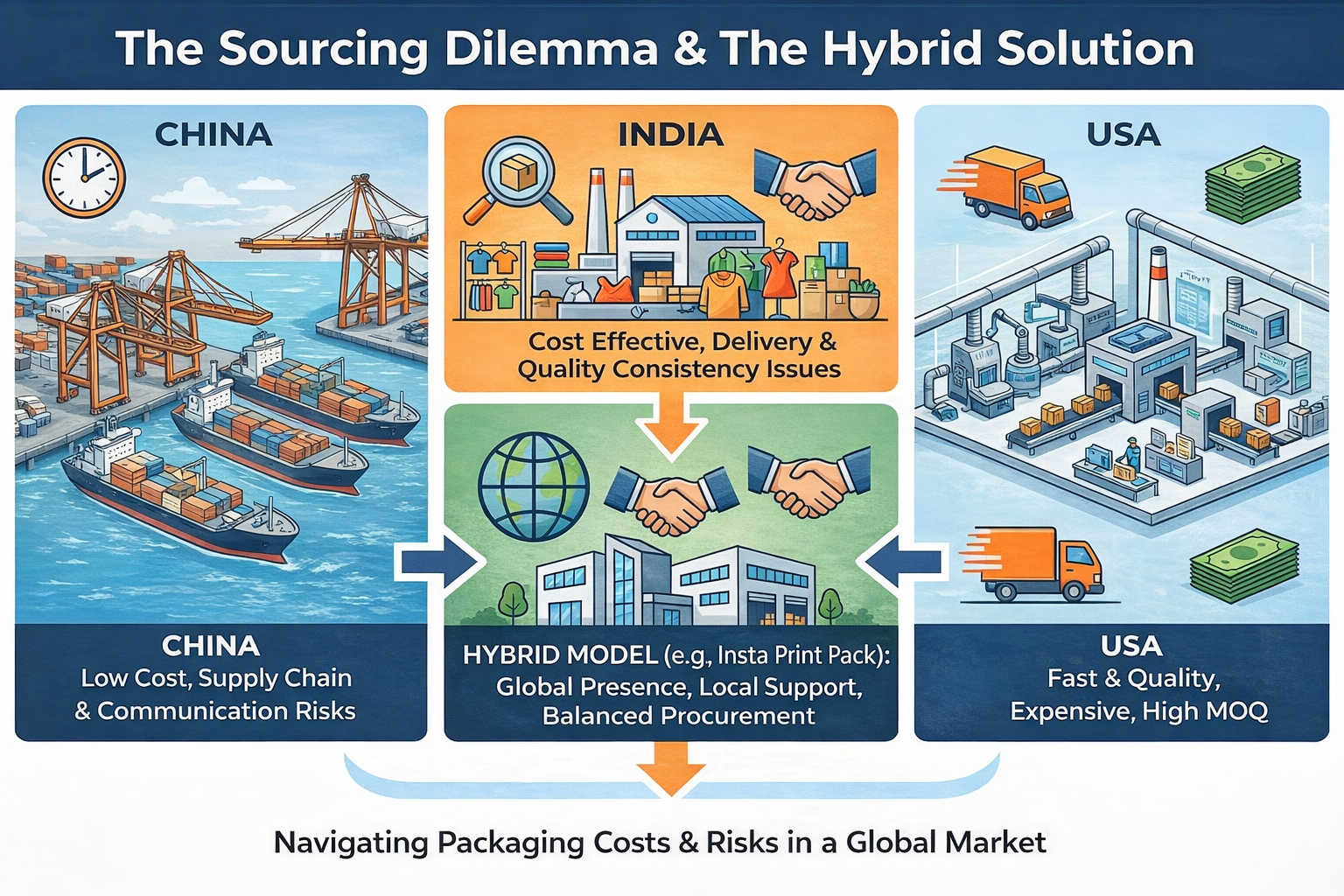
China has long been a dominant force in global packaging manufacturing. Its scale, infrastructure, and ability to handle large production volumes remain strong advantages.
Despite its advantages, sourcing packaging from China now involves notable challenges:
While cost-effective on paper, these risks can disrupt planning and inflate overall procurement costs.
India has emerged as a strong alternative for global packaging manufacturing, offering competitive costs and expanding production capacity.
Sourcing from India also requires careful management:
India offers significant potential, but success depends on governance, quality control, and supply chain coordination.
Domestic packaging manufacturing remains the most reliable option for many brands, particularly those with tight timelines or strict quality requirements.
While dependable, domestic-only sourcing can strain margins and limit scalability.
The global packaging market has exposed a fundamental flaw in traditional sourcing strategies: brands are forced to choose between low cost with high risk or high cost with low risk.
In a volatile global environment, this trade-off is no longer sustainable. Procurement teams need sourcing models that deliver both cost efficiency and operational reliability.
To address these challenges, many brands are adopting a hybrid approach to packaging procurement.
A hybrid packaging model combines:
This approach reduces dependency on any single geography while maintaining competitive pricing.
Global manufacturing supports cost efficiency, while local operational presence enables faster decision-making, oversight, and contingency planning.
Hybrid models often involve tighter control over manufacturing standards, reducing batch-to-batch variation and minimizing rework.
With regional backup capabilities, brands are better positioned to respond to delays, disruptions, or demand fluctuations.
Not all hybrid approaches are equal. Effective models typically include:
These elements help align cost savings with operational stability.
In today’s market, the true cost of packaging includes more than production pricing. It also reflects:
Procurement strategies that consider these factors achieve better long-term outcomes than those focused solely on unit cost.
Global packaging sourcing has entered a new phase. Cost-driven decisions without risk assessment are no longer sufficient in a complex, interconnected supply chain environment.
Modern packaging solutions must balance global efficiency with local reliability, ensuring consistency, visibility, and resilience. Hybrid sourcing models offer a practical path forward, one that aligns procurement goals with operational reality.
For brands navigating today’s sourcing dilemma, the most effective strategy is not choosing the cheapest option, but choosing the most dependable one. Contact Us for more information.
Because logistics disruptions, geopolitical instability, and inconsistent lead times have increased unpredictability.
Yes, but it requires risk management, visibility, and contingency planning.
Competitive costs and growing infrastructure, when supported by proper quality control.
Higher labor, compliance, and operational costs drive higher pricing.
A sourcing approach that combines global manufacturing with local oversight to balance cost and reliability.