
29/04/2026




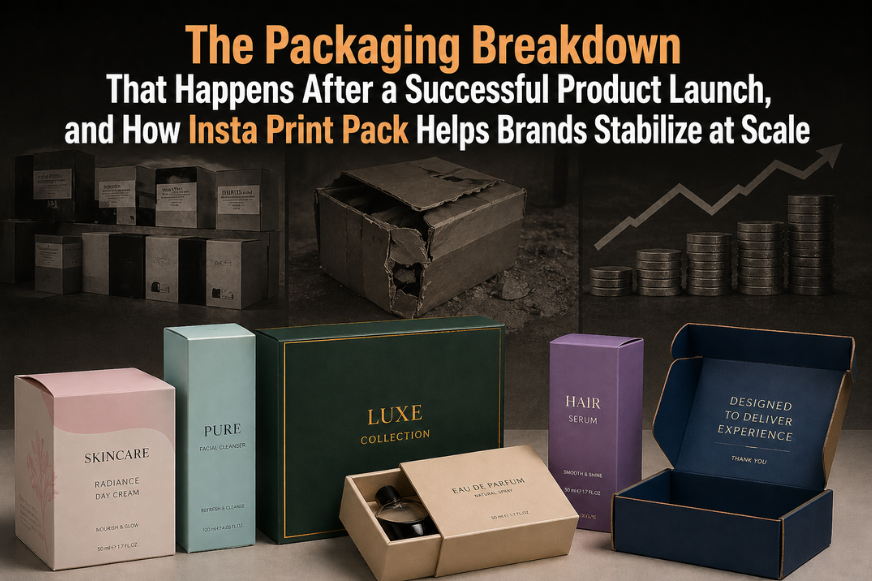
Most brands prepare intensely for a product launch. The formula, the design, the marketing — every detail is reviewed before the first unit ships. What very few brands prepare for is what happens six months later, when the launch succeeds and orders start coming in faster than anyone expected.
Reorder cycles shorten. New sales channels open. And the packaging solution that worked well at launch starts to crack under real, sustained growth pressure.
A packaging solution designed for launch conditions is rarely built for scale. The gaps surface in quality inconsistencies, rising costs, and supplier relationships that were never meant to handle the volume your brand now demands. This article explains what breaks after a successful launch, why it happens, and how to stabilize before the damage reaches your customers.
Q. Why does packaging start becoming a problem when business orders start increasing rapidly?
At launch, packaging feels manageable — one design, one supplier, predictable volumes. When orders increase rapidly, that setup cracks. Suppliers struggle to match the pace, reorder cycles shorten faster than lead times allow, and quality varies across batches. What worked at 500 units a month does not work at 5,000. Without the right packaging solution in place, this gap widens as the business grows.
A successful launch creates pressures that most brand teams do not anticipate in their packaging planning. The assumption is that launch is the hard part. Sustaining it at increasing volume is significantly more demanding.
McKinsey research on consumer goods scaling identifies operational failures — including packaging inconsistencies — among the top three reasons fast-growing brands lose momentum within 18 months of launch. The product performs. The packaging operation does not keep pace.
The core problem is structural. Launch-stage decisions are made under time pressure with limited volume commitments. The systems built for that context do not automatically scale. Most brands discover this only after a visible breakdown.
At low volumes, a single production run delivers consistent output. As batches multiply, small variations in ink density and print calibration accumulate into visible differences. Inconsistency across custom packaging boxes signals poor quality control to buyers — even when the product inside is identical.
Growing brands frequently find that packaging cost rises faster than volume. Emergency reorders carry premium pricing, small batches lose economies of scale, and repeated SKU changes generate setup costs. Without consolidated production, cost per unit climbs steadily — erosion that often goes unnoticed until a quarterly review.
Launch volumes move through limited distribution. At scale, the same packaging faces warehouses, logistics operators, and courier handling it was never tested for. Packaging failure — crushed corners, broken seals, delamination — follows. Every failure reaching a customer carries a credibility cost the brand absorbs.
The packaging and printing companies in India suited to small-volume launch runs are not always equipped for fast-scaling programs. When order frequency increases and lead times compress, suppliers begin to slip — late deliveries, quality shortcuts, and fragmentation across your packaging supply chain.
A brand that launched with two SKUs often has eight or more within eighteen months. Without a structured system for managing product packaging across a growing range, design errors and label inaccuracies become common — creating compliance issues, retailer rejections, and shelf performance damage.
Solving post-launch packaging breakdown requires a packaging solution capable of managing the full operational complexity that growth introduces — not just a supplier switch.
The right packaging solutions at scale address four things simultaneously: consistent print quality across batches, reliable lead times as volume increases, structured SKU management, and packaging cost control through consolidated production planning.
Most packaging and printing companies in India operate as transactional suppliers — producing what is ordered, managing nothing beyond the print run. Brands scaling need a partner that functions as a complete operational system.
The problems that surface after a successful launch — batch inconsistency, cost inflation, supplier gaps, SKU complexity — require a packaging solution built specifically for the post-launch scaling challenge.
Calibrated commercial printing processes maintain colour accuracy across batches regardless of volume. Every unit reaching a customer looks identical to the last — regardless of when it was produced.
Design files, label specifications, and production records must be managed across a brand's full SKU range. When a new variant is added, the packaging solution must accommodate it without disrupting existing production.
Consolidating production and planning schedules in advance keeps per-unit costs predictable as volume grows — rather than escalating through emergency reorders and fragmented supplier arrangements.
Production capacity planning built into every brand program keeps lead times stable as order frequency increases — so brands avoid the supplier crunches that cause stock-outs at critical growth moments.
Insta Print Pack works with growing brands that have moved past launch and need operational support built for scale. Batch inconsistency, supplier capacity gaps, and SKU complexity — these are the exact problems this team is structured to solve through a complete packaging management program covering print quality, SKU file management, production scheduling, and cost planning.
Audit Your Packaging Operation Before a Problem Forces You To
Do not wait for a quality failure or missed delivery to review your setup. A structured audit at the six-month post-launch mark identifies gaps before they become customer-facing problems.
Consolidate Suppliers Before SKU Count Grows Further
Consolidating production with a single capable partner reduces inconsistency, simplifies reordering, and creates economies of scale that split-supplier arrangements cannot achieve.
Build Packaging Lead Times Into Product Planning, Not Around It
Packaging lead times should inform product launch schedules — not chase them. Brands that treat packaging as a final step consistently face avoidable delays at critical sales moments.
A successful product launch is the beginning of the operational challenge, not the end of it. Quality inconsistency, rising costs, supplier capacity gaps, and SKU management complexity are predictable consequences of growth without a structured packaging solution in place.
Brands that invest in a packaging solution built for scale maintain the consistency their early customers came to expect. The launch is behind you. What comes next deserves the same preparation. For more information, Contact Us.
Why does packaging quality drop after a brand starts scaling quickly?
Scaling increases batch frequency and volume beyond what launch-stage suppliers and systems were built to handle.
What causes packaging cost to rise unexpectedly during growth?
Emergency reorders, small-batch pricing, and duplicated setup costs across multiple suppliers steadily erode per-unit margins.
What is packaging failure and how does it affect brand credibility?
Physical damage in transit — crushed boxes, broken seals — that reaches customers and damages brand trust directly.
How does Insta Print Pack support brands with multiple SKUs?
Insta Print Pack manages design files, production schedules, and quality control across a brand's full SKU range centrally.
When should a growing brand consolidate its packaging supplier relationships?
Before SKU count grows further — earlier consolidation reduces coordination complexity and avoidable per-unit cost increases.