
26/07/2026




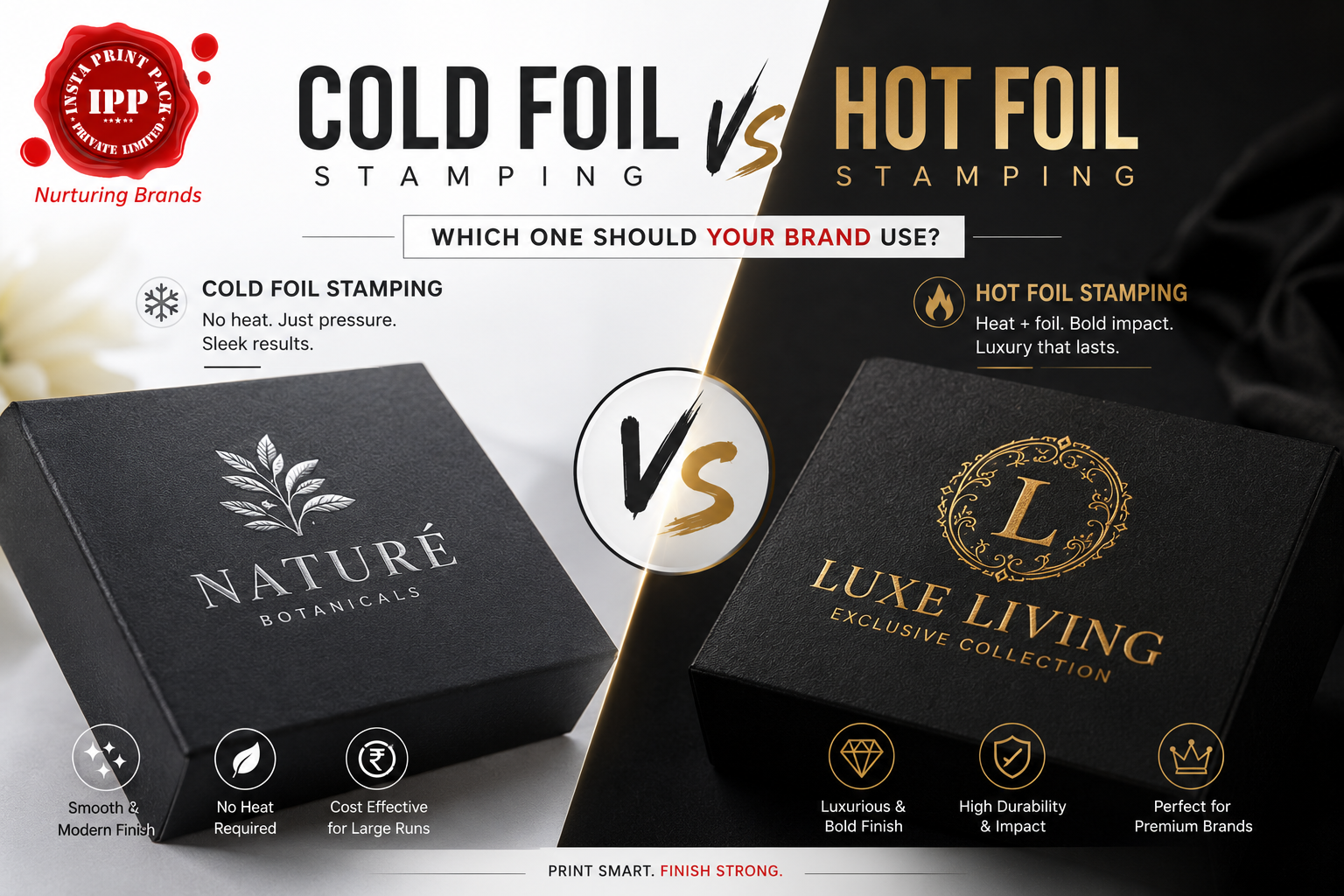
If you've ever held a business card, wine label, or cosmetic box that seemed to catch the light with a metallic shimmer, you've already seen foil stamping in action. But when brands sit down to choose a finishing technique for their packaging or print materials, one question comes up again and again: cold foil vs hot foil stamping which one actually fits your product?
Both methods create that same eye-catching, reflective look, but they rely on completely different equipment, processes, and cost structures. At INSTAPRINTPACK, we work with brands across the country to help them decide which foiling method suits their design, budget, and production timeline. In this guide, we'll walk through how each process works, where each one shines, and how to make the right call for your next print run.
Hot foil stamping is the traditional foiling method. It uses a heated metal die that presses a thin layer of foil film onto paper, cardstock, or packaging material. The heat and pressure combine to transfer the foil only onto the raised areas of the die, creating crisp, detailed designs think fine text, intricate logos, or delicate line art.
Because the die is custom-made for each design, hot foil stamping delivers exceptional sharpness and depth. It's often combined with embossing to create a raised, tactile effect that feels as premium as it looks. The trade-off is setup time and cost: custom dies take time to produce, which makes hot foil stamping better suited to larger production runs where the upfront investment gets spread across more units.
Cold foil stamping skips the heat entirely. Instead, an adhesive is printed onto the substrate in the exact shape of the design, foil is applied over it, and the foil bonds only to the adhesive areas. The process typically runs inline with offset printing, meaning foiling and printing happen in a single pass.
This makes cold foil stamping significantly faster and more cost-effective for high-volume jobs, and it also opens the door to full-color foil effects and gradients that hot foil stamping can't easily achieve. The downside is that it generally can't produce the same fine detail or embossed texture as hot foil stamping, since there's no die pressing into the material.
| Factor | Hot Foil Stamping | Cold Foil Stamping |
| Process | Heated die presses foil onto material | Adhesive + foil applied inline with printing |
| Detail Level | Very high, sharp fine lines | Good, but less crisp than hot foil |
| Embossing Option | Yes, easily combined | Limited or not available |
| Setup Cost | Higher (custom die required) | Lower (no die needed) |
| Best For | Short to mid-size runs, luxury finishes | High-volume runs, full-color foil effects |
| Turnaround Speed | Slower for large orders | Faster, runs inline with printing |
| Cost at Scale | Rises with die complexity | More economical per unit |
Pros:
Cons:
Pros:
Cons:
This decision usually comes down to three things: order volume, design complexity, and budget.
If you're still unsure which route fits your product, our team at INSTAPRINTPACK routinely guides clients through sample runs of both methods before committing to a full production order, so you can see and feel the difference firsthand.
As a growing packaging company in usa serving multiple industries, the company works with businesses across the packaging industry us, offering solutions that go well beyond foil stamping. Operating as a reliable container company in usa and a full-service packaging business in usa, the team supports everything from a food packaging company in usa need to specialized packaging design company in usa projects.
Recognized among the best packaging company in usa and counted as one of the biggest packaging company in usa providers, the business also serves growing ecommerce packaging company usa clients and offers sustainable packaging company usa options for brands prioritizing eco-friendly materials. As a trusted packaging products manufacturer usa, the company ships to clients from a packaging company texas location all the way to a packaging company california base, and everywhere in between.
There's no universal winner in the cold foil vs hot foil stamping debate — the right choice depends entirely on your product, your run size, and the finish you're trying to achieve. Hot foil stamping wins on detail and texture; cold foil stamping wins on speed and cost at scale.
Partner with INSTAPRINTPACK to get expert guidance on your next project, including a side-by-side sample comparison so you can make the decision with confidence rather than guesswork.