
24/01/2026




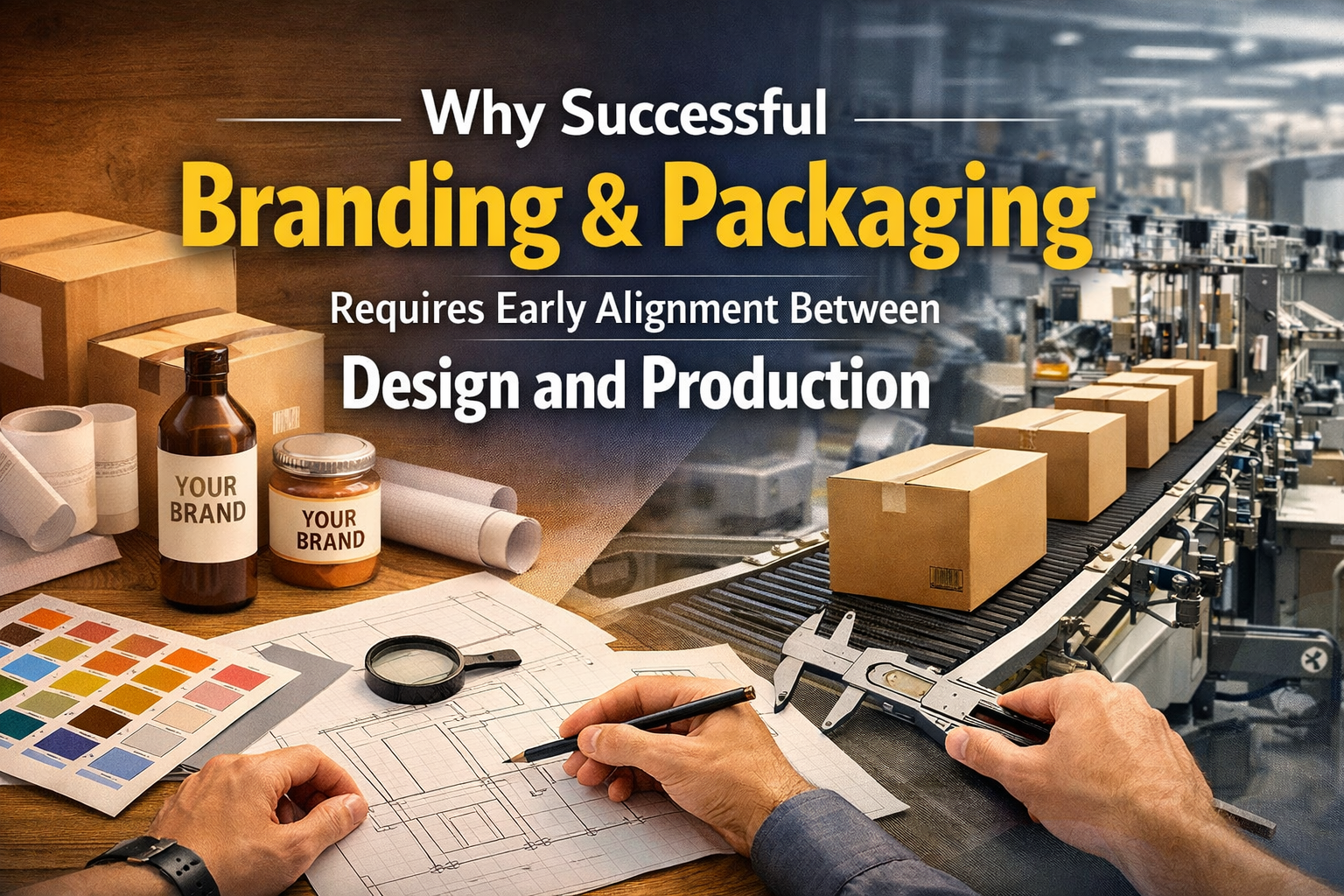
Branding and packaging often start as creative exercises. Designers focus on colors, typography, finishes, and visual impact. Production teams focus on materials, machinery, timelines, and cost. Problems arise when these two functions work in isolation.
In many packaging projects, design decisions are finalized long before production realities are considered. This disconnect leads to delays, rework, cost overruns, and inconsistent brand presentation. Successful Branding & Packaging depends on early alignment between design intent and production execution.
Q.1 Is early alignment between packaging design and production essential for brand consistency?
Yes, early alignment helps prevent rework, controls costs, and ensures that the final packaging reflects the intended brand quality.
Branding defines how a product should be perceived. Packaging is how that perception is delivered in the real world. If packaging cannot be produced reliably at scale, branding efforts lose impact.
Strong Branding & Packaging is not just about appearance. It is about repeatability, durability, and consistency across every unit produced. That consistency can only be achieved when production considerations are part of the design process from the start.
Many packaging issues start at the concept stage. Designers may select:
Without early production input, these decisions look good in mockups but fail in real manufacturing conditions.
When production teams are involved late, they often identify issues such as:
By this stage, redesigns are expensive and timelines are already under pressure.
Brand value depends on consistency. When design and production are aligned early:
This is critical for brands producing multiple variants or expanding product lines.
Late-stage changes are one of the biggest drivers of packaging cost overruns. Early alignment allows teams to:
This approach supports packaging solutions that are efficient without diluting brand perception.
Custom packaging solutions are most effective when they are planned collaboratively. Structural design, material selection, and finishing must all support the brand’s positioning.
Early alignment ensures:
Custom packaging should enhance branding, not create downstream challenges.
Material selection is often driven by appearance rather than performance. However, materials behave differently during printing, cutting, folding, and finishing.
Early production involvement helps teams evaluate:
These considerations are essential for reliable packaging solutions at scale.
Lamination affects both durability and appearance. Matte, gloss, and specialty laminations behave differently depending on:
When lamination services are planned late, brands may face cracking, peeling, or visual inconsistency. Early testing and alignment prevent these issues.
Labels and stickers are often treated as separate elements, but they are part of the overall packaging experience. Misalignment between packaging design and labels & stickers can lead to:
Early coordination ensures labels integrate seamlessly with the primary packaging.
Production planning is not just an operational task. It directly influences how a brand is experienced by customers.
Early alignment helps ensure:
This planning supports branding goals by ensuring that what customers see matches what the brand promises.
Rework is expensive and disruptive. It often occurs because:
Aligning design and production early reduces revisions, shortens approval cycles, and keeps launches on schedule.
As brands grow, packaging complexity increases. New SKUs, markets, and volumes amplify any misalignment between design and production.
Early alignment supports scalability by:
This is especially important for brands planning long-term growth.
Successful packaging workflows involve:
This collaboration transforms Branding & Packaging from a reactive process into a strategic advantage.
Branding and packaging do not succeed in isolation. Design defines intent, but production delivers reality. When these two functions align early, brands gain consistency, efficiency, and control.
Early alignment between design and production helps prevent costly rework, protects brand integrity, and enables scalable packaging systems. For brands focused on long-term growth, this alignment is not optional, it is essential. Contact Us for more information.
It ensures that design intent can be executed consistently and efficiently in production.
It prevents late-stage changes, reprints, and material waste.
Not when production input is included early in the design process.
Incorrect lamination decisions can cause durability and visual issues if not planned early.
They affect compliance, durability, and overall brand consistency.